
Showing posts with label Android Tablet. Show all posts
Showing posts with label Android Tablet. Show all posts
Thursday, October 4, 2012

Thursday, August 16, 2012
Panasonic ToughPads Scooped-Up by AT$T - delayed by Apple's 7-inch offering?

A little birdy just alerted my that Panasonic's $1,395 10-inch AI and $895 7-inch B1 Android 4.0 production runs have been totally scooped up by AT&T and one of the major cable companies for their field staff. So no goodies till Spring 2013 or until Panasonic pulls their head out. Could this be one of those Apple-plays to grab any and all 7-inch screens that Panasonic offers up?
"The Toughpad 10 inch A1 and the 7 inch B1 tablets both have an MIL-STD-810G and an IP65 certification, and use the Android Honeycomb OS. Thier screens are uniquely readable in broad daylight and come with multi-touch features too. The screen has an anti-glare feature, enabling the tablet to use a finger and pen touch input."
MidNight Mapper
Tuesday, August 7, 2012
Small Apples - Scuffle...
iPad Mini Could Dampen Android Tablet Sales


| July 12, 2012 2:18PM |
 Industry analysts expect Apple to take the wind out of the sails of its tablet
  rivals by launching a new iPad mini in a 7-inch or 8-inch form factor in time for this year's holiday shopping season.
"If Apple launches a sub-$300, 7-inch product into the market later this year as rumored, we expect the company's grip on this market to become even stronger," said Tom Mainelli, a research director at IDC.
Piper Jaffray believes Apple could sell 4 million to 6 million mini-iPad devices during this year's traditionally strong holiday shopping season -- equivalent to 20 percent of total iPad sales in the fourth quarter
"The most successful Android tablets' key points of differentiation are price and size," noted Piper Jaffray analysts Gene Munster and Douglas Clinton on Monday.
tablets' key points of differentiation are price and size," noted Piper Jaffray analysts Gene Munster and Douglas Clinton on Monday.
"Strategically, we believe the launch of a smaller screen, cheaper iPad eliminates the two biggest unique features for Android tablet makers," Munster and Clinton wrote in an investor note.
Lower Price Points Ahead
Though total Android shipments dropped sharply in the first quarter, Google is hoping that the 7-inch Nexus tablet it is building in partnership with Asus will help to reverse the trend. Slated for launch later this month, the Nexus 7 will enable Google to ensure that the new devices stay up to date with each new release of Google's Android platform.
"The search giant's new tablet will run a pure version of Android, whereas the [Kindle] Fire runs Amazon's own forked version of the OS that cuts Google out of the picture," Mainelli said.
Still, other tablets are coming that will directly compete with Apple 10.1-inch iPad offerings. For example, Microsoft's ownWindows RT-based tablet is expected to launch as early as October.
RT-based tablet is expected to launch as early as October.
The price of Microsoft's first new Surface tablet will be a critical factor when it comes to winning over consumers. Moreover, ARM-based Win 8 tablets will enter the market without the backward compatibility -- and installed base -- that most people expect from a Windows machine, and so their "success in the tablet market is far from guaranteed," Mainelli said.
To compete in the tablet market with Apple, Mainelli said, rivals must introduce products at notably lower price points than Apple's iPad.
"We expect a new, larger-screened device from Amazon at a typically aggressive price point," he said.
Apple has been making all the right strategic decisions to ensure that its tablet market dominance continues unabated.
"Apple's move to position the iPad as an all-purpose tablet -- instead of just a content
consumption device -- is resonating with consumers as well as educational and commercial buyers," Mainelli said. "And its decision to keep a lower-priced iPad 2 in the market after it launched the new iPad in March seems to be paying off as well."The release of an iPad mini in advance of this year's holiday shopping season could continue the trend -- especially if it is priced at $299 with 16GB of storage, given the $199 8GB iPod Touch and $399 16GB iPad 2, according to Piper Jaffray.
Potential Android Killer
"We believe the smaller iPad, while potentially cannibalizing 10 percent of full-size iPad sales, could take 30 percent of total Android tablet sales in the December quarter," Munster and Clinton said.
IDC forecasts that Apple will retain a 60.8 percent share
of the global tablet market in 2016 -- up from the firm's prior forecast of 58.2 percent. Likewise, Piper Jaffray remains confident about Apple's tablet sales."Longer term, we remain confident that Apple will maintain a majority, and potentially increasing, share in the tablet space," Munster and Clinton said.
Friday, May 25, 2012
I'd rather have a ToughPad B1 - Rampage - 2.3 Android Hardened Handset 5.7" Display DOA?
I guess Juniper is a Android want-to-be.. A clunky device originally designed for WinCE and Micorsoft's WIn8 Mobile... IMHO is DOA to any other than those ESRI-ites that do not know better?
Juniper Systems Partners with SDG Systems to Produce the RAMPAGE™ 6, the Mesa Rugged Notepad® with Android (AOSP) Operating System
Logan, Utah, USA – Juniper Systems is proud to announce its partnership with Pennsylvania-based SDG Systems. This partnership will bring to market the Mesa Rugged Notepad® with Android (AOSP) 2.3 operating system, a rugged handheld computer known as the RAMPAGE™ 6 and distributed exclusively through SDG Systems. Availability of the RAMPAGE 6 is scheduled for the third quarter of 2012 and its first public presentation will be at the Esri International User Conference in San Diego, July 23–27, 2012.
The Panasonic is Andorid ICS as well as having a superior 7 inch display for $1200 - the "Rampage".


“Our new partnership with SDG Systems will further enhance our ability to provide the best rugged handheld computing solutions to our customers. By working together, we have created a very unique and in-demand handheld computer with the Android (AOSP) operating system, now known as the RAMPAGE 6,” said Rob Campbell, President and CEO of Juniper Systems. “Leveraging the Android expertise of SDG gives our customers an original and powerful data collection device and we couldn’t be more excited about the opportunities this new partnership will bring.”
The Android (AOSP) 2.3 operating system on the RAMPAGE 6 offers many advantages for data collection, including easy multi-tasking, a modern user interface, rich programming environment, multi-platform development, abundant application data storage, open source flexibility, and the opportunity for a custom Android interface developed by SDG Systems. Additionally, its optional kiosk mode allows only certain applications to be accessible by the user, successfully creating a single-purpose device without distractions.
“SDG Systems is proud to develop and distribute the RAMPAGE 6 as our very first SDG-branded handheld computer. Collaborating with Juniper Systems on a product as unique and dependable as the Mesa Rugged Notepad has made this experience very rewarding and we’re excited to put the SDG name on it. Our decision to develop Android (AOSP) for the Mesa was based on its extreme ruggedness, quality design, and dependability. I am confident that the RAMPAGE 6 will live up to those standards,” said Todd Blumer, President and CEO of SDG Systems.
The RAMPAGE 6 will feature the many advantages and benefits of the Mesa Rugged Notepad, including a large 5.7 inch viewing display, IP67 ingress protection rating for water and dust, integrated 2–5 meter GPS receiver, optional integration of a 1D/2D barcode scanner, and optional Class I, Division 2 certification for use in hazardous locations.
Monday, May 21, 2012
Panasonic Toughpad A1 Available EOM June?

$1,795 plus shipping... includes 4G LTE
otherwise
$1,395
Toughbook Toughpad A1
- Broadband : 4G LTE Wireless Broadband +$400.00
- Warranty Options : Preferred Warranty 3 YR ( + 0.00 )
Wednesday, March 28, 2012
ToughPad ... any day now?

Looks like the "best Hard-Droid" is still open for best dressed. Who gets the reference design crown? Will it be Googleola or Panasonic? Available mid-Summer is the newest rumor... $1395 without the 4G card at $495...
Toughpad FZ-A1
The 10.1" Android™-powered Toughpad FZ-A1 is ideal for highly mobile outdoor workers in challenging conditions, it's designed to meet durability standards on drop resistance as well as meeting ingress protection ratings on dust and water.
The CPU in the tablet incorporates a dedicated security processor, which provides a high level of tamper resistance and frees up the multi-purpose CPU core for other tasks. The business matte, anti-reflective screen with digitizer provides true daylight visibility together with 10 hours' battery life, integrated GPS and replaceable battery.

Android™ 4.0
Marvell® dual-core processor
Dedicated security processor core, FIPS 140-2 Level 2 compliant
10.1" anti glare capacitive Multi-Touch Display and Digitizer
Up to 500cd/m” brightness with anti reflection film
Satellite GPS and digital compass
Up to 10 hours battery life
Replaceable battery
Drop resistant from a height of 120cm, MIL-STD 810G compliant*
Water / Dust protected, IP65 compliant*

* Tested at Panasonic Factory.
Google, the Google logo, YouTube and Android are trademarks of Google Inc.
Sunday, March 18, 2012
Panasonic Toughpad FZ-A1 10.1-inch Android tablet


Panasonic’s ToughPad A1 android tablet computer was officially announced. It has 10.1 inch XGA LED display with the resolution of 1024 x 768. It runs Android 3.2 Honeycomb and and is powered by a 1.2GHz, dual-core processor built by Marvell as well as 1GB of RAM.
The ToughPad A1 Android tablet computer is expected to ship in the spring of 2012 with a price tag of $1299. Measuring 266.7mm x 211mm x 17mm or 10.5in x 8.3in x 0.67in, the rugged tablet has 16GB internal storage, and supports up to 32GB microSD cards.
The company also announced another tablet called B1 tablet which will be available next year. The ToughPad A1 Android tablet computer is also equipped with 5 megapixel camera on the back as well as a 2 megapixel camera up front.
Panasonic’s ToughPad A1 Android tablet supports optional 4G LTE or WiMAX connections and of course to 802.11 a/b/g/n Wi-Fi connectivity.
SPECIFICATIONS:
General 2G Network N/A
Size Dimensions 266.7 x 213.4 x 17.8 mm
Weight 952.5 g
Display Type LCD capacitive touchscreen
Size 768 x 1024 pixels, 10.1 inches (~127 ppi pixel density)
Multitouch Yes
- Anti-reflective and anti-glare display
Sound Alert types N/A
Loudspeaker Yes
3.5mm jack Yes
Memory Card slot microSD, up to 32GB
Internal 16 GB storage, 1 GB RAM
Data GPRS No
EDGE No
Speed No
WLAN Wi-Fi 802.11 а/b/g/n, Wi-Fi hotspot
Bluetooth Yes, v2.1 with A2DP, EDR
USB Yes, microUSB v2.0
Camera Primary 5 MP, 2592x1944 pixels, autofocus, LED flash
Features Geo-tagging
Video Yes
Secondary Yes, 2 MP
Features OS Android OS, v3.2 (Honeycomb)
CPU Dual-core 1.2 GHz Marvell
Sensors Accelerometer, compass
Messaging Email, Push Email, IM
Browser HTML, Adobe Flash
Radio No
GPS Yes
Java Yes, via Java MIDP emulator
Colors White
- MIL-STD-810G and IP65 certified sealed all-weather design
- Magnesium alloy chassis encased with ABS and elastomer
- FIPS 140-2 (HIPPA compliance)
- micro HDMI port
- MP3/WAV/WMA/AAC player
- MP4/H.264/H.263 player
- Organizer
- Predictive text input
Battery Standard battery, Li-Ion 4590 mAh (33.9Wh)
Stand-by
Talk time Up to 10 h
Friday, March 16, 2012
Google Earth - IsWhere arrives...
Google Earth for Android and iOS reaches version 6.2, supports custom KML overlays and more

Friday, February 24, 2012
Hard-Droid... totally awesome Tablets for battle
Harris Corporation Chooses Android To Power Ruggedized Tablets For Defense And Public Safety Communication

Harris Corporation, an international communications/IT company catering specifically to government and commercial markets, officially unveiled their own 7" Android-powered tablet today, meant to provide a rugged tool for the transmission of "mission-critical" communication for defense and public safety. The tablet is specifically aimed at military personnel and first responders, who "require secure real-time information at their fingertips to execute their missions."
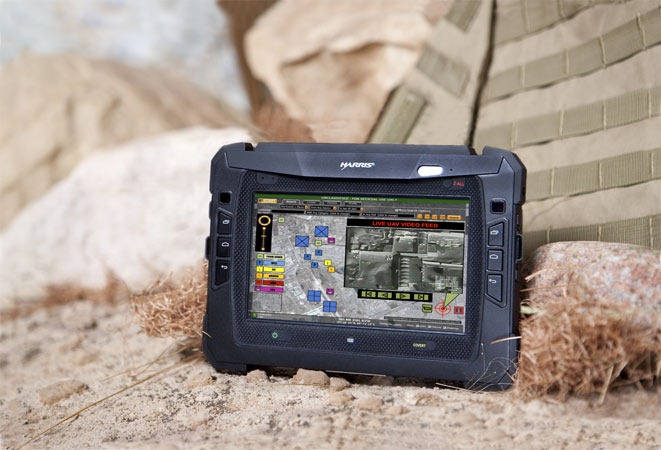
The tablet has been graded as a ruggedized device, meaning it can stand up to extreme heat, cold, or other rough environments and still provide critical functionality to its users. Dana Mehnert, group president of Harris RF Communications ...
Motorola Working On Ruggedized Android Tablet, Presumably For Rugged Individuals
NSA And Google Developing Hardened Android Kernel For Government Communication; Will Be More Secure Than BlackBerry
Sunday, February 5, 2012
Secure Android and the Army Universal Remote
U.S. Government & Military To Get Secret-Worthy Android Phones
 The amount of stuff we trust to fly in and out of our smartphones is astounding. Just look at what happened when a couple of reporters got access to an unwitting (and rather unlucky)Apple employee’s iMessages alone — within days, they learned more about him than most people know about their closest friends.
Now, imagine all the stuff that could fly in and out of a government official’s phone, or that of a highly-ranked member of the military. Forget saucy texts and booty pictures — we’re talking about state secrets, here.

Looking to keep their secrets underwraps while on the go, the U.S government is working on a build of Android custom-tailored to meet their security requirements.
Word of the project comes from CNN, who notes that U.S. officials/soldiers aren’t currently allowed to send any classified data over their smartphones. If they need to transmit anything that might sink ships (so to speak), they currently need to find a secured (generally meaning hardwired) line hooked to an approved device.
Here’s the gist of the project:
- A limited number of soldiers will get the phones first, then federal agencies, then possibly contractors
- The U.S. won’t be building their own hardware — that’d be too expensive. Instead, they’ll be buying commercially available devices and reflashing them.
- They hoped to be able to offer iOS devices, but it’s not going to happen. CNN notes that federal officials met with Apple to request that they share their source — as you’d probably guess, Apple wasn’t too cool with that idea.
- Surprisingly, users of the handsets will be able to install new applications, though the handsets will put a specific emphasis on exactly what information the application can access and what it’s currently sending. Seems unlikely that they’d give these things full Android Market access, though — that’d be rather silly.
- The project is being funded by DARPA, with the NSA evaluating it as they go (while working on a version of their own, curiously.)
Army Tests ‘Universal Remote’ for
Future Troopers
from Danger Room


This new experiment — called theCommon Controller & Man packable Network Interoperability and Network Evaluation Experiment — is supposed to bring sensor data from these unmanned systems to smaller units equipped with Land Warrior gear.
An example: In the experiment, a Common Controller operator sent out a robot to recce a building. The ‘bot spotted a someone exiting a vehicle that appeared to be loaded with explosives. The operator then snapped a pic of the suspect’s image and sent it — along with a text message — to a Land Warrior-equipped platoon. The digital grunts then set up a checkpoint and snared the bad guy.

In real life, things probably won’t be that simple. But the experiment did test the ability to pass information down to the individual soldier on the ground. Instead of just sucking up information from networked vehicles or robots into a tactical operations center, this kind of system has the potential to distribute it to individual troopers.
Lt. Col. James McNulty, product manager for the Common Controller team, said in an Army news release the experiment proved out three things. “First, we were able to push data and imagery collected by networked sensors down to small unit leaders at the company and below level,” he said. “Second, we connected platoons and companies together and finally we were able to send data and real time information up into the network.”
Thursday, January 5, 2012
Google's Next Tablet - Motorola where are U?
Rumour: Google To Launch 7-Inch Nexus Tablet In Late Q1 2012

Late last year Google chairman Eric Schmidt commented to an Italian newspaper that "in the next six months [Google planned] to market a tablet of the highest quality". His statement generated much speculation primarily over whether Google planned on releasing a self-branded "Nexus" tablet or whether they would merely partner with a device manufacturer, such as Motorola, Samsung, or HTC.
According to a rumour from Taiwanese electronics daily DigiTimes, Google may be preparing to launch an "own-brand tablet PC...targeting Amazon's 7-inch Kindle Fire". Naturally, Google Taiwan has already released a statement indicating that it has "never heard about plans of ...
Monday, December 5, 2011
Intel remains Wintel and AMD thinks about AMDroid
Unofficial Android 4.0 x86 port gets aid from AMD, not Intel
Electronista updated 10:35 pm EST, Fri December 2, 2011
fragments platform
The unofficial first Android 4.0 x86 port won't get help from Intel, the company's Google program lead Alec Gefrides said in an interview Friday. He noted to EE Times that the Android-x86 project, which is focused on bringing Android to traditional PCs, was largely a straight compile of the basic source code with generic PC support that wasn't Intel's focus. Intel was focused only on optimizing Android for Atom-based phones and tablets, and a spokeswoman added that supporting Android-x86 might fragment the platform further.
Gefrides was "happy" that Android-x86 existed, but by its nature, the project wouldn't have the drivers for the wide range of hardware on full-size PCs. There was also a concern that any improvements wouldn't be folded back into the official Android Open-Source Project.
Android-x86's creator, Chih-Wei Huang, was meanwhile frustrated with Intel's lack of support. However, he had received active support from AMD, ranging from hardware samples to advice from engineers. AMD isn't an official member of the AOSP and doesn't have much say over how the Google-blessed x86 port is made.
Regardless of AMD's involvement, Gefrides said Intel's work on Android porting was largely done and that plans for phones in early 2012 were largely on track. "We're just focusing on how to get the phones out as fast as we can," he said.
Intel has been hoping for chips in phones since the start of 2010. Its slowness in shrinking and optimizing the Atom, however, has let ARM take smartphones largely uncontested. Its Medfield platform and beyond will be the first versions efficient enough to fit into phones and truly mobile tablets, and were enough to get full Android support with Google's help.
Read more: http://www.electronista.com/articles/11/12/02/intel.says.outside.android.port.fragments.platform/#ixzz1fgFUGNSm
Sunday, December 4, 2011
NVIDA makes their move - Transformers

Posted by Aaron Gingrich in ASUS,
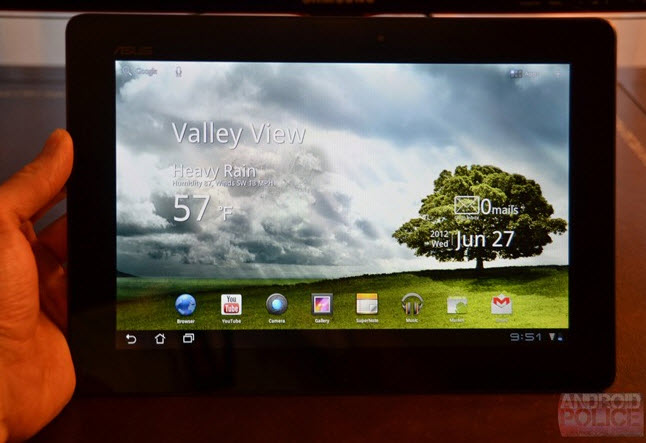
The Asus Transformer Prime: the first Android device to ship with a quad-core chip, courtesy of NVIDIA's brand new Tegra 3 (Kal-El) CPU. But there's more of a hook here than power alone - Asus has gone back to the drawing board for the Prime (model number TF201) and revamped the device from nearly head to toe compared to its predecessor, the TF101. It's substantially thinner, lighter, and more attractive than the rather portly 101, while packing a much more powerful CPU, better display, and reportedly better battery life. But can they really improve upon all those aspects without cutting any corners? I've spent a few more days with the TP since posting my initial impressions on Wednesday - enough time to get a solid feel for the ups and downs of the new tablet.
On top of the more efficient processor, Asus has packed in three performance modes: "Normal" mode is effectively high performance, with everything capable of running at full speed as needed (up to 1.4GHz for a single core and 1.3GHz for multi-core). "Balanced" caps the CPU at 1.2GHz, and "Power saver" mode sets the ceiling at 1GHz for single/dual-core modes, 700MHz when three cores are being used, and 600MHz when all four main cores are active. Presumably other tweaks are made as well - in power saver mode, the screen dims and adjusts brightness based on what's displayed on the screen (though that can get just a bit annoying - scrolling up and down quickly on a site with images will visibly brighten/darken the screen).
The Asus Transformer Prime: the first Android device to ship with a quad-core chip, courtesy of NVIDIA's brand new Tegra 3 (Kal-El) CPU. But there's more of a hook here than power alone - Asus has gone back to the drawing board for the Prime (model number TF201) and revamped the device from nearly head to toe compared to its predecessor, the TF101. It's substantially thinner, lighter, and more attractive than the rather portly 101, while packing a much more powerful CPU, better display, and reportedly better battery life. But can they really improve upon all those aspects without cutting any corners? I've spent a few more days with the TP since posting my initial impressions on Wednesday - enough time to get a solid feel for the ups and downs of the new tablet.
On top of the more efficient processor, Asus has packed in three performance modes: "Normal" mode is effectively high performance, with everything capable of running at full speed as needed (up to 1.4GHz for a single core and 1.3GHz for multi-core). "Balanced" caps the CPU at 1.2GHz, and "Power saver" mode sets the ceiling at 1GHz for single/dual-core modes, 700MHz when three cores are being used, and 600MHz when all four main cores are active. Presumably other tweaks are made as well - in power saver mode, the screen dims and adjusts brightness based on what's displayed on the screen (though that can get just a bit annoying - scrolling up and down quickly on a site with images will visibly brighten/darken the screen).
Conclusion
There's a lot to take into consideration here. First, we're looking at a lot of all new technology and some impressive capabilities that heretofore haven't been seen. Not only does it pack more power and new features, but it manages to do so in an even smaller package than we're used to, and at a decent price point, to boot. On the one hand, a starting price of $500 seems like a weakness... until you consider that a 32GB Galaxy Tab 10.1 costs $600 despite no longer having the lead in sex appeal, and being blown out of the water on the hardware front. Then again, a lack of a $400 16GB model could put the Prime above what some people can afford, and that's unfortunate, because it's quite the tablet on its own - throw the $150 dock into the equation, and you've got a hell of a device on your hands.
Battery Life/Performance Modes
NVIDIA claims that the Tegra 3 boasts some of the best battery life in the business, while packing added power. We've already seen that their claims on power are right, but what about the improved battery life? I'm happy to report that their claims seem to hold merit, thanks in part to a fifth core dubbed the "companion core." (For more details on the T3's tech specs, hit up our primer.)
There's a lot to take into consideration here. First, we're looking at a lot of all new technology and some impressive capabilities that heretofore haven't been seen. Not only does it pack more power and new features, but it manages to do so in an even smaller package than we're used to, and at a decent price point, to boot. On the one hand, a starting price of $500 seems like a weakness... until you consider that a 32GB Galaxy Tab 10.1 costs $600 despite no longer having the lead in sex appeal, and being blown out of the water on the hardware front. Then again, a lack of a $400 16GB model could put the Prime above what some people can afford, and that's unfortunate, because it's quite the tablet on its own - throw the $150 dock into the equation, and you've got a hell of a device on your hands.
Battery Life/Performance Modes
NVIDIA claims that the Tegra 3 boasts some of the best battery life in the business, while packing added power. We've already seen that their claims on power are right, but what about the improved battery life? I'm happy to report that their claims seem to hold merit, thanks in part to a fifth core dubbed the "companion core." (For more details on the T3's tech specs, hit up our primer.)
Thursday, December 1, 2011
Tablet hunting.... first blood?

First Android 4.0 build arrives for Intel x86 platform

The developers are still working to resolve lingering issues with sound, cameras, Ethernet connections and graphics acceleration for Intel chips.
Although Intel recently announced that it was collaborating with Google to bring Android support to its Atom chipsets, Android-x86 team member Chih-Wei Huang suggests the unofficial project has received no help from the chip maker. AMD, however, is said to "provide great support," including device donation and engineering assistance.
The team has released an Android 4.0.1 variant optimized for AMD's Brazos APUs.
Read more: http://www.electronista.com/articles/11/11/30/developers.still.working.out.bugs/#ixzz1fINeq950
Monday, November 28, 2011
Panasonic Android ToughPad FZ-A1MIL-STD-810G
By Paul Ridden
12:09 November 14, 2011
Although consumer tablets like the iPad are now being used for much more than watching videos, checking emails, or playing games - such as assisting disabled voters, or breaking into new musical ground - they're not nearly tough enough to meet the needs of the mobile worker. You could, of course, simply enclose your tablet in a rugged outer shell or waterproof it in some WaterWear, but there are better options available.

Panasonic has a fair pedigree when it comes to mobile computing toughness - enjoying a 65.3 percent share of last year's European rugged and durable notebook computer market - and says its new Toughpad FZ-A1 is built to perform where other tablets fail. The Android 3.2 tablet has a wide operating temperature range of -10 °C to 50 °C (14 °F to 122 °F), should be able to withstand a drop from four feet (120 cm) in a powered-off state, and benefits from the same ingress resistance rating as Panasonic's somewhat chunky Toughbook H1 Field Windows tablet.
At its heart beats a Marvell 1.2GHz dual-core processor incorporating an SoC-compliant dedicated security processor core with FIPS 140-2 Level 2. This handles software and data encryption, enhanced VPN, authentication, trusted boot and device management, and protects against tampering. The processor is supported by 1GB of SDRAM and 16GB solid state storage - with SDHC media card expansion.
The 10.1-inch, 1024 x 768 pixel resolution capacitive touchscreen display couples anti-glare/reflection film with up to 500 nit brightness for daylight-friendly use, and includes an active digitizer that records pressure, direction and speed along with the signature for greater legal authority when signing documents. It comes supplied with a battery-free digitizer pen, and the tablet's Lithium-ion battery is said to power it for about ten hours of usage between charges and can be replaced/upgraded by the customer's IT support team.
There's 802.11b/g/n Wi-Fi, Bluetooth 2.1 with EDR, optional 3G, built-in satellite GPS and a digital compass. Physical connectivity takes the shape of a single micro-HDMI port and one micro-USB 2.0 port, video and photographic needs are met by a 2 megapixel front-facing webcam and a 5 megapixel camera with LED flash at the rear, and security measures include Marvell hardware-assisted storage encryption, Marvell Trusted Boot, and Authentec Mobile Security.

All of this looks impressive enough until it's compared with other equally tough cookies like the Motion CL900 from Motion Computing - which features a Corning Gorilla Glass screen, slightly better resolution, more onboard storage and a faster main processor.
Panasonic Computer Products Europe says that its 10.5 x 0.67 x 8.35-inch (226.3 x 17 x 212 mm), 2.13 pound (970g) Toughpad FZ-A1 is set for second quarter availability at an estimated price of EUR850 (US$1,158) for the standard tablet and EUR999 (US$1,361) for the 3G-enabled model, prices include a 3-year warranty. The release is supported by a host of accessories, such as vehicle mounts, desktop cradles and hands-free holsters.
Panasonic has also revealed that a 7-inch model will follow in the second half of 2012.
Thursday, June 16, 2011
But can you see it now? Bight Light?
by Matt Burns on June 16, 2011

Tablets tend to be delicate devices, most comfortable being used on a cushy couch or over the safety of a study table. But not the just-announced Panasonic Toughbook Android tablet. It’s a Toughbook product and brings along years of design innovations that allows it to live in the real world. It is, perhaps, the world’s first blue-collar Android tablet.
Nothing is missing. The Toughbook tablet has everything you’d expect in a modern tablet: GPS, “full-shift” battery life, 3G/4G options, but also a bright, daylight viewable 10.1-inch XGA matte screen compatible with an included active stylus. Since it’s a Toughbook product, not having a protective, glossy shield over the screen probably won’t be an issue. This isn’t Panasonic’s first go at a rugged tablet.

No word on pricing, release date or even what version of Android this tablet runs. One of the promo images shows the tablet running a 2.x release, but the press release specifically does not mention the OS number, which might mean it’s not finalized yet. Panasonic might be holding the MSRP and release date until that detail is worked out. (Please let it be Honeycomb)
Panasonic Toughbook to Address Market Void by Delivering Enterprise-Grade Android TabletDevice to include enterprise-scale security, functionality and durability for government and commercial mobilityInfoComm 2011
Booth 3829
SECAUCUS, N.J.–(BUSINESS WIRE)–Panasonic Solutions Company, provider of collaboration, information-sharing and decision-support solutions for government and commercial enterprises, today announced its plans to deliver an enterprise-grade Android™ tablet to the market in the fourth quarter of this year. The new Toughbook® tablet will address a current gap by delivering a product designed with security, functionality and real-world reliability in mind. By delivering this purpose-built business solution, the new Toughbook tablet will appeal to a wide variety of users, including mission critical government personnel, highly mobile field forces, SMB’s looking for a competitive edge, security conscious IT managers and bottom-line focused CFOs.“The vast majority of tablet devices—regardless of the OS—are engineered for consumers and don’t offer appropriate levels of security and durability or the functionality needed for business use. Like all Toughbook products, our Toughbook tablet will be designed and constructed with the mission-critical mobile user in mind.”
“Enterprise customers are very interested in the tablet market, but have been frustrated by the lack of appropriate solutions,” said Rance Poehler, president, Panasonic Solutions Company. “The vast majority of tablet devices—regardless of the OS—are engineered for consumers and don’t offer appropriate levels of security and durability or the functionality needed for business use. Like all Toughbook products, our Toughbook tablet will be designed and constructed with the mission-critical mobile user in mind.”From a functionality standpoint, the Toughbook tablet will avoid the typical glossy screens—found on current tablet offerings—that are all but unreadable in outdoor environments. The Toughbook tablet will include a high brightness, daylight viewable screen so that mobile workers, in markets like field service, home healthcare and public safety, can easily see critical data and operate the device regardless of lighting conditions. The new tablet will also include an active stylus, allowing mobile workers in sales, customer service and mobile point-of-sale environments to capture signatures on the device’s 10.1” XGA multi-touch display.Enterprise-class mobile computing requires a heightened level of device security that is not currently available in today’s tablet market. To address this need, the new Toughbook tablet is being designed with security embedded at the hardware level.The Toughbook brand is widely known for its reliability and durability, even in extreme operating environments. The new Toughbook tablet will be no exception, offering durability, and ingress protection consistent with its other fully-rugged devices.Other features to be offered on the Toughbook tablet include satellite-based GPS, full-shift battery life, professional-grade accessories and optional embedded 3G/4G mobile broadband connectivity.Combined with mobile broadband connectivity, the Android-based Toughbook tablet will offer quick access to applications and data that could significantly improve a field worker’s ability to make critical decisions that enhance customer service, improve response times and deliver results.The device is being shown at Panasonic’s InfoComm booth (3829) in Orlando, FL. InfoComm runs through Friday, June 17.
Friday, May 20, 2011
Analyst: Early Android Tablet Entries Can't Compete With iPad [Digital Daily]
“If you were to ask me in two years’ time, will Apple have less than 50 percent of the global tablet market, I think that’s a certainty.”– Neil Mawston, Strategy Analytics, January 2011

The iPad’s dominance of the market for tablet computers may not prove as short-lived as some analysts have predicted. Though beset by a proliferation of new rivals, particularly those based on Google’s Android operating system, the company’s share of this fast-growing market isn’t eroding nearly as quickly as expected.
Why? According to Jeffries analyst Peter Misek, Android tablets simply aren’t competitive. “We have thus far been very disappointed with nearly every Android-based tablet,” said Misek–so disappointed that he’s slashed his 2011 tablet forecast to 70 million units from 100 million. In his opinion, Android tablets won’t come close to rivaling the iPad until their OS is more refined and their prices come down.

“[Android] Honeycomb is an OS that seems rushed and still requires significant polishing,” Misek says. “Our own multiple-week interaction with Honeycomb tablets showed daily crashes, bugs, and program hangs. Yet our iPad has yet to experience any of these trends or idiosyncrasies.”
And beyond this, Android tablets are simply too expensive.
“We believe there is significant price elasticity in the market, and these additional tablets have all in our view failed in one key category: providing a compelling discount to the iPad,” he explains, adding that Android tablet OEMs must cut prices if they’re ever to establish a beachhead against Apple’s tablet.
Eventually, says Misek, Android tablets will be quite competitive with iOS tablets, but not until these issues are addressed. Until then, the iPad will continue to dominate.
Friday, January 14, 2011
STATS: Android has 25% of global smar...
STATS: Android has 25% of global smartphone market, will grow at “twice” the rate of others in 2011
Tech analyst Canalys is BULLISH on Android for the coming year, claiming that the recent meteoric growth the mobile OS has seen shows no sign of stopping.
In fact, its latest projections for 2011 have Android as growing as TWICE the speed of its competitors. Here’s a nice little quote from Canalys Principal Analyst Chris Jones:
“The growth of Android has been phenomenal, but so too has the number of related devices launched with different hardware and software specifications … This has led to the market perception of it as a fragmented platform, though we believe that growth will continue as the pace of Android OS upgrades slows”
And here’s a graph showing global smartphone shipments for Q3 2010. Android is described here as the “OHA” – Open Handset Alliance:

Way to go, Symbian!
Subscribe to:
Posts (Atom)