$1,000 Optical Device
Wednesday, January 7, 2015

Thursday, December 11, 2014
Next Generation of Android Camera API...
Samsung Galaxy NX brings Android to interchangeable lens cameras
I guess this shouts “game on”? It is generally known that Android as a design started as a camera control system that morphed into the open source and dominating hand-held communicator OS with digital camera as a central core feature. Not certain exactly what this is going to offer our kit but I feel there is an opportunistic moment right in front of us.
GizMag June 22, 2013 By Simon Crisp
Camera FV-5 Updated With Support for Android 5.0 Camera API - Droid Life: A Droid Community Blog
http://www.droid-life.com/2014/12/10/camera-fv-5-updated-with-support-for-android-5-0-camera-api/
via Digg Reader
Wednesday, December 10, 2014
Precision Ag Monitoring - 5-Channel Global Shutter RedEdge(tm)
 RedEdge™ is much more than just a camera, sharing more design features with Earth imaging satellites than it does with standard consumer cameras. Industrial imaging sensors provide high dynamic range in varying lighting conditions while removing artifacts commonly seen in drone video and imagery. Coupled with MicaSense Data Services, RedEdge™ provides a complete imaging, processing, and analysis system ready for integration with any platform.
Need a closer look? Unplug your RedEdge™ and go handheld. An integrated shutter button lets you take close-ups of areas of interest, and with the optional GPS module, maintain geo-tagging and time-stamping of all of your multispectral images.
- More than just pretty pictures - simultaneous capture of five discrete spectral bands optimized for crop health data gathering.
- Fly fast - we can keep up! Capturing all bands once per second enables faster flight speeds and lower altitude captures.
- Distortion-free - global shutter design creates distortion-free images on every platform.
- Single card - tired of juggling multiple cards? With RedEdge™, one SD card stores all images and data for easy data transfer.
- Metadata included - all image files are time-stamped and geo-tagged, no third party tools or autopilot logs required.
- Fully calibrated - leave your integrating sphere at home, we have you covered. Every camera comes fully calibrated for precise, repeatable measurements every time.
- Stand-alone - with external GPS connections and self-triggering capability, easily collect geo-tagged data without any connections to the host vehicle.
- Data at your fingertips - With Wi-Fi built in, preview images and change settings from your phone, tablet, and computer.
- Fully integrated - our convenient host interfaces allow tight integration with any platform, enabling full data capture by providing GPS data and power.
- No moving parts - solid-state design means nothing to break on those dusty days or the occasional harsh landing.
| Weight | 190 g (6.7 oz) |
|---|---|
| Dimensions | 4.8” x 2.9” x 1.5” (12.2 cm x 7.4 cm x 3.8 cm) |
| Spectral Bands | Narrowband filters for Blue, Green, Red, Red Edge, Near-Infrared |
| Ground Sample Distance | 5.4 cm/pixel (per band) at 200 ft (60 m) AGL |
| Capture Speed | 1 capture per second (all bands), 12-bit RAW |
Saturday, November 15, 2014
Friday, October 24, 2014
Getac T800 - My next computer? Maybe....
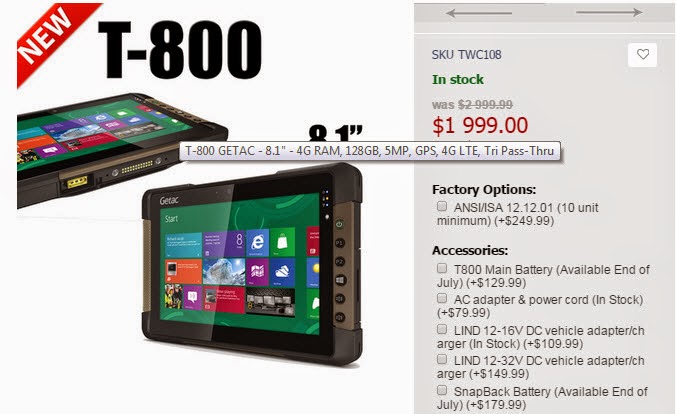
Getac announces the availability of the new Getac T800, fully rugged tablet with Windows 8 displays with 8.1 ” .
Getac Announces Availability of Getac T800 on the market, the new tablet from 8.1″ withWindows 8 operating systems, designed specifically to support the productivity of those who work outdoors. Relatively thin and light, Getac T800 has been designed on the basis of the specific need’s operators and technicians who work outdoors in areas such as utilities, providing field services and Public Safety.
Getac T800 offers size not comparable to the tablet Windows for the consumer market, yet is small enough to be transported even in hostile environments for most of the electronic devices. With a thickness of 24mm and a weight of 880g, Getac T800can be taken, according to the company, in a pocket or a hand, giving the user power, reliability and versatility of a typical Windows system.
Getac Announces Availability of Getac T800 on the market, the new tablet from 8.1″ withWindows 8 operating systems, designed specifically to support the productivity of those who work outdoors. Relatively thin and light, Getac T800 has been designed on the basis of the specific need’s operators and technicians who work outdoors in areas such as utilities, providing field services and Public Safety.
Getac T800 offers size not comparable to the tablet Windows for the consumer market, yet is small enough to be transported even in hostile environments for most of the electronic devices. With a thickness of 24mm and a weight of 880g, Getac T800can be taken, according to the company, in a pocket or a hand, giving the user power, reliability and versatility of a typical Windows system.
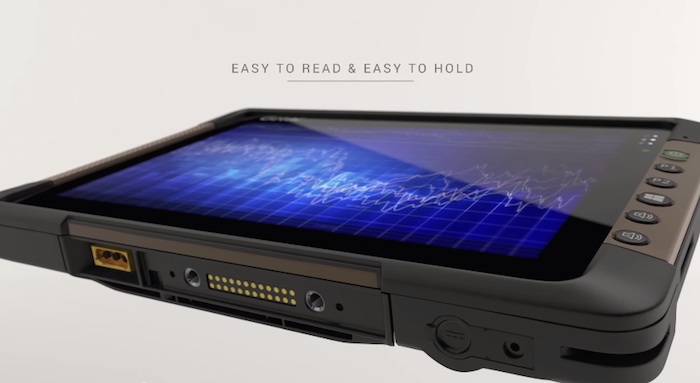
With the SnapBack can also add extensions to the tablet, such as a second battery that allows you to prolong the battery life up to 16 hours. Regarding the characteristics of resistance, Getac T800 is IP65 certified and meets the requirements of the American military MIL-STD-810G: in other words, it manages to survive to shock, drop, vibration and intrusion of liquid and powder, of course within certain limits.
The processor integrated in the tablet is an Intel Pentium N3530, quad-core 2.16 GHz processor, supported by 4GB of RAM DDR3L. Given the nature of the device, Getac has decided to introduce a datasheet cell phone compatible with 4G LTE networks (optional), as well as support networks and Wi-Fi 802.11ac functionality geolocation via GPS SiRFStar IV. Noteworthy also is the monitor, according to data released by the company.

Thanks to the technologies and LumiBond QuadraClear proprietary panel 8.1″ LCD TFT 1280×800 unable to reach a value of maximum luminance of 600 nits without drastically compromising the autonomy of the device. Getac T800 is also available and can be ordered in a wide range from 64 to 128GB of storage built-in.
Getac T800 – Technical Specification
- Intel Pentium 2.16 GHz N3530
- Operating System Windows 7 or Windows 8
- Tablet Dimensions: 227 x 151 x 24 mm
- Multi-touch display 8.1 ” 1280×800 600nits
- Weight: 880 g. 64GB / 128GB SSD
- SiRFstarIV GPS ™
- Rugged Full, MIL-STD-810G, IP65
- Super fast WiFi: 802.11 ac
- Extensive connectivity, antenna design patented 3D internally
- Expansion with SnapBack: 2-1 player barcode and RFID Battery or optional
- Battery life: 8 hours / 16 hours with battery SnapBack
- Tri RF pass-through (WWAN and WLAN and GPS).
360 by 270 for under $800?
Record everything with this dive-friendly 360-degree action
cam
by Steve Dent | @stevetdent | 37 mins ago
by Steve Dent | @stevetdent | 37 mins ago

Using a single lens and sensor eliminates the need to "stitch" video and photos -- instead, you can swipe across the video to pick the angle you want, then edit it together using the 360fly app. As for the rest of the specs: according to the FCC guide, it's waterproof to a whopping 164 feet (5 atm) with 16GB of memory, a 360 degree horizontal and 240 degree vertical f/2.5 lens, a mic and a 1,504 x 1,504 1/2.3-inch CMOS sensor. It can hold a charge for 2 hours, weighs 138g (0.3 pounds) and comes with a tilt mount, power cradle and USB port. You may have noticed that I didn't mention an SD card -- it looks like it'll make do with 16GB of internally memory only, with large transfers to your mobile device by WiFi.

Rather than tackling sports cam stalwarts like GoPro directly, the 360fly is trying to carve its own niche by capturing video from all around the photographer without the complexity of multiple lenses. EyeSee360 must have a convincing case, because it raised $17.8 million from bullish investors. Though the company promised it for this summer, it looks like its ready to at least take a step towards the market now that it's cleared the FCC. Some of the specs might be revised in the interim, but for now, the manual is marked "Reviewer's Guide," so hopefully we'll get our mitts on it soon.
Thursday, October 23, 2014
Killing off Counterfeit COM... the end is near?
Driver changes fake FTDI chip settings, renders it unusable
A recent Windows Update is causing trouble for people working with Arduino microcontrollers and other similar projects, by making some hardware inoperable. A driver update for FTDI chips as part of the Windows Update is apparently damaging the software on some USB-to-serial components, with counterfeit chips suddenly becoming inoperable.
Due to the prevalence of FTDI serial chips in hobbyist electronics, there are now many fake chips on the market claiming to be from FTDI, and function using previous official drivers. Hack A Day warns that the new drivers do not merely prevent the counterfeit chips from working with Windows Systems, as they change the code on the chips so that the Product ID (PID) is 0000, making them effectively unusable on any other platform
Though damaging, the issue can still be reversed, as FTDI does offer a configuration tool which can be used to change the PID. Even so, it will change back to 0000 again if it comes into contact with the newer drivers.

Ars Technica notes that the EULA for the drivers includes some new terms, advising the use of the driver with "a component that is not a Genuine FTDI Component, including without limitation counterfeit components, may irretrievably damage that component." It is unclear if the drivers are acting in a malicious way or not, as it is possible the counterfeit chips are misinterpreting commands and causing the issues, rather than it being an attempt by the company to damage the fake components.
FTDI has yet to comment about the issue. When questioned, Microsoft refused to comment and referred Ars Technica to FTDI over the matter.
Read more: http://www.electronista.com/articles/14/10/23/driver.changes.fake.ftdi.chip.settings.renders.it.unusable/#ixzz3GzXUtkxF
Subscribe to:
Comments (Atom)