Saturday, December 15, 2012

Compass Stuff...


Here is a list of current handheld GPS receivers sporting an electronic compass (most also offer a barometric altimeter):
ModelType
Garmin Astro 320 dog tracking system3-axis
Garmin Dakota 203-axis
Garmin eTrex 303-axis
Garmin fenix3-axis
Garmin Foretrex 4012-axis
Garmin GPSMap 62s3-axis
Garmin GPSMAP 62sc3-axis
Garmin GPSMap 62st3-axis
Garmin GPSMAP 62stc3-axis
Garmin GPSMAP 78s3-axis
Garmin Montana 6003-axis
Garmin Montana 6503-axis
Garmin Montana 650t3-axis
Garmin Oregon 4503-axis
Garmin Oregon 450t3-axis
Garmin Oregon 5503-axis
Garmin Oregon 550t3-axis
Garmin Rino 6503-axis
Garmin Rino 655t3-axis
Lowrance Endura Sierra3-axis
Magellan eXplorist 6103-axis
Magellan eXplorist 7103-axis
Magellan SwitchUp3-axis

Thursday, December 13, 2012

Video by Vectors


The pixel does the job for most digital imagery -- it sure makes for a fine shirt -- but it's not so hot for video, where growing resolutions chew up gobs of bandwidth. There may be a wiser strategy coming from the University of Bath, whose researchers have developed a more efficient approach to movie codecs. Their new format uses vectors to render footage with colored contours that demand fewer resources than a dot-by-dot approach. While vector-based rendering isn't original in itself, the researchers' method is supposedly unique in filling the gaps between the contours with the kind of visual quality a pro videographer would crave. The university team is confident enough that it's talking to major companies about using the codec for post-production tools, and sees it spreading to mobile devices where connection speeds and storage are at a premium. It could take years for vector-based video to catch on; if the technology ever upsets the pixel's reign, though, more than a few Vectrex owners may see it as poetic justice.

Wednesday, December 12, 2012

Apple Achieves Satisfaction as Number 2


Google’s Eric Schmidt On War With Apple, “We’re Clearly Winning”

In an hour-long interview with Bloomberg, Google’s Eric Schmidt touched on a few things, namely the ongoing “war” as some would call it with Apple Inc. Luckily for Schmidt, he doesn’t have to do much convincing when says Googleis “winning.” In a recent analysis, it showed Google holding to a strong market share of 72% in Q3, while Apple sat at 14%. Schmidt declared that 1.3 million Android devices are activated daily, a number that only seems to go up and up.
Another interesting subject that was lightly touched on was Google’s overall plan for Android. By creating a free platform that allows hardware makers to gain revenue from, Google takes the initial loss, but knows the overall future profits will outweigh them significantly. By creating a new market for advertisements and other Internet-based services, Android will help usher Google onto the road ahead.
The core strategy is to make a bigger pie. We will end up with a not perfectly controlled and not perfectly managed bigger pie by virtue of open systems.
Classic Eric Schmidt.
ViaBloomberg

Green Battery


Scientists develop eco battery powered by root-extracted dye

DNP Scientists develop eco battery powered by rootextracted dye
Scientists have been figuring out how to develop eco-friendly ways of recharging batteries for years, from harvesting temperature fluctuations to harnessing your fidgets. But perhaps a better solution is to create a different kind of battery altogether; one that uses greener sources instead of finite ingredients like cobalt. That's exactly what the whiz-kids from the City College of New York, Rice University and the US Army Research Laboratory have done with a new lithium-ion battery powered by red dye extracted from madder roots.

Called rose madder or purpurin, the dye was apparently used in ancient civilizations for dying fabrics in oranges, reds and pinks. Fortunately for the future of the battery, it turns out its color molecules are also carriers of carbonyl and hydroxyl groups that make it ripe for use as an electrode and that purpurin is far easier to process than other organic materials: "These aromatic systems are electron-rich molecules that easily coordinate with lithium," said CCNY Professor George John. It'll likely take years before we'll get to the point of mass production of these things, but in the future we could finally say that batteries do indeed grow from trees.

Sunday, December 9, 2012

BlueStacks... an interesting threat?


BlueStacks Hits 5M Installs, Rumored To Be Bringing 750K+ Android Apps To Windows RT Devices

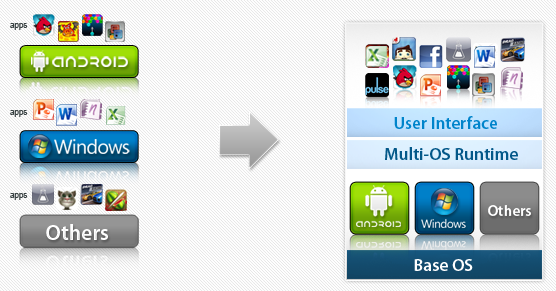
new-bluestacks-logoIt appears that BlueStacks isn’t just a flash in the pan. The Silicon Valley-based startup, which makes software that allows users to run their Android apps on Macs and PCs, said today that it has passed 5 million organic installs through its homepage. Vanity stats like this are annoying, yes, but what’s notable is that BlueStacks hit this milestone in under eight months. And the news comes on top of its recent partnerships with AMD and Asus, which have announced their intention to pre-load BlueStacks’ technology on over 100 million units.

In September, BlueStacks announced a partnership with chipmaker AMD, which brought its app catalog to AMD-powered Windows 7 and Windows 8 machines through the launch of its new app store, AppZone. As Sarah pointed out at the time, much like AppUp, Intel’s app store for PCs that “has been optimized to run on Intel-powered Ultrabooks,” with AppZone, the chipmaker optimized BlueStacks’ technology for AMD GPUs and APUs.

Of course, it was only a matter of time before the chipmakers began implementing the startup’s technology, as AMD was the lead strategic investor in BlueStacks’ $6.4 million series B raise in October of last year. The round brought the company’s total investment to $15 million and saw AMD join investors like Andreessen Horowitz, Ignition Ventures, Citrix and Qualcomm.

It’s unusual for software makers and manufacturers like Citrix, Qualcomm and AMD to show up on the same roster of investors, yet, as Sarah said, it was a demonstration of an eagerness among investors to leverage the Windows ecosystem as a platform to run Android apps.

The partnerships with AMD and Asus and its backing from Qualcomm also set the stage for BlueStacks to team up with additional manufacturers to pre-install its technology on PCs. The big-picture goal for the startup is to help bring the some 750K Android apps to each and every one of the billion-plus PC users out there. It’s a sizable opportunity, another part of the reason investors (and chipmakers) are eager to test the waters.

BlueStacks’ technology allows users to run graphics-intensive Android apps on desktop PCs via its patent-pending “Layercake” technology, which initially enabled Android apps to be compatible with x86-based PCs, followed by Macs, and now includes those developed for ARM processors — Angry Birds Space and Fruit Ninja being two familiar examples. (More on this below.)

The company has been looking to build a developer platform, as well, and has been partnering with the makers of apps like Fruit Ninja, SliceIt!, Townsmen, Evernote, StumbleUpon and Barnes & Noble (Nook). The main selling point being that developers don’t have to modify or port their apps to run them on PCs, which means less heavy lifting for those who have already developed apps for Android.

To this point, HandyGames CEO Christopher Kassulke let it slip last night at Mobile Gaming Europe that HandyGames will be launching their uber popular Clouds and Sheep as a PC game using BlueStacks. And the more big app development houses begin signing on, the more BlueStacks thinks that it’s helping to create a crack in the wall between mobile and PC gaming.

But here’s what could be most exciting for developers (and users) looking at developing for (or buying) Windows mobile devices. The newly released Windows RT, for those unfamiliar, is a special version of Windows 8 built for mobile (specifically ARM) devices — so, really, tablets. If somehow you haven’t noticed, Microsoft has been pushing its new Surface tablets pretty aggressively since their initial release in late October, partly manifesting through that snappy, percussive ad campaign you’ve probably seen by now on the tube. The main mobile OS being offered by the Surface? Windows RT.

As of now, consumers can buy a number of ARM-powered Windows RT devices, and there are more coming. But Surface currently has the highest profile among these tablets and devices, yet, the problem is that they’re not selling as well as Microsoft would have hoped. According to Tech Report, MSFT’s initial order of 4 million Surface devices has been cut in half thanks to slow sales.

Leaving the device itself out of it, probably the biggest reason for this boils down to apps. Compared to iOS and Android, few developers have built native apps for Windows 8. Even if consumers want to buy the Surface, many would rather opt for an Android or iOS device, because they offer far more access to the apps we’ve all grown accustomed to using on a daily basis.

So, naturally, rumors have begun to mount that BlueStacks’ next project will be to make its tech available to Windows RT users. As evidenced in this forum, hilariously, it appears that Microsoft salespeople have even begun to suggest using BlueStacks if users want to buy a Windows device and get access to Android apps.

The Droid Guy was one of the first to pick up on the BlueStacks, Windows RT rumors, as a BlueStacks team member recently divulged in a separate forum that the company was in the process of bringing those 750K+ Android apps to Windows RT. BlueStacks Engineer Deepak Sharma, via The Droid Guy: “We are considering offering BlueStacks for Windows RT next year.”

BlueStacks team members approached by TechCrunch would not confirm that this is in fact happening, but from what we’ve been able to gather from other sources, it seems there’s a good chance this could happen in early 2013.

However, as The Droid Guy points out, Microsoft’s Windows Defender could pose problems in this regard, as it could force BlueStacks to release its own app on the Windows Store, which, knowing Microsoft, would likely be disapproved. Until then, BlueStacks works well with Windows 8 Pro-based tablets and devices, but if BlueStacks is able to produce an ARM version of its technology, this could be a big boost both for the startup and for those looking for access to a viable app platform on their new Windows device.

With support for both ARM and Windows 8 Pro, developers could significantly increase their distribution without having to develop native apps for Windows devices — great for them but, again, not something that Microsoft is likely to get too jazzed about.

For more, find BlueStacks at home here.

Friday, December 7, 2012

Apple Glass...


Apple Patent A Reminder That It’s Working On Google Glass-Style Wearable Tech, Too

puppy-glassesAn Apple patent published yesterday by the USPTO and unearthed by Patently Apple is a reminder that Apple was actually working on wearable tech in the form of content-delivery glasses, at least on paper, long before Google debuted Google Glass. Apple originally filed a patent for its own Glass Project back in 2006, and this latest patent sketches out the details for a device that could someday go head-to-head with similar offerings from both Google and Microsoft.

In the new patent, Apple describes a “portable presentation device” which could be any device that a user wears that also provides them with access to visual or audio media content. It’s a fairly broad description, and I think that’s the intent: Apple has always had a habit of patenting ideas first, and worrying about bringing them to market later. That’s why the company is in such a strong position with regards to smartphone patents, despite actually being a relatively late entrant to the market vs. other cell phone makers.

The patent goes on to note that a portable presentation device could take the form of “a set of goggles that fit over the user’s eyes with display and perhaps sound producing capability, a faceplate that covers the front of the user’s face with display and perhaps sound producing capability, or any other headwear that has display and perhaps sound producing capability.” They could also contain sensors to detect a user’s presence, and in one version of the system described, the device is able to tell from how it’s being worn whether the user wants it to be active or not – so that lifting glasses with the tech built-in, for instance, would pause media playback.

So far, it sounds like Apple is essentially describing what could be an iOS-powered version of the virtual big screen home video goggles already available on the market, but the patent also describes ways in which they could activate communicate features, like making a phone call or connecting to a video conference. It also describes potential integration of live media services, streamed from Internet sources, as well as cable or satellite, yet another indication Apple is actively looking into the future of television.

Apple’s vision is still more focused on wearable media delivery, versus the AR-type features that Google is making the central feature of its Project Glass device, which is also where Microsoft seems to be headed according to its own recent patent filing. But all of these massive tech companies are clearly trying to plant their flags for the next stage of mobile tech, which begins to look increasingly like it’ll take the form of something we wear, not something we carry.

Distributed Sensors... and Smartphones


Army Biologist Developing NextGen Tools for Soldiers

U.S. Army scientists are developing new technologies, including smartphones that detect and identify chemical and biological agents, to empower soldiers.


Dr. Calvin Chue, a research biologist with the U.S. Army Research, Development and Engineering Command, or RDECOM, is focused on the next generation of devices to protect soldiers and civilians against unknown chemical or biological threats.

“The biggest threat is always going to be the emerging pathogen, the things you hear about on the news where pools of disease pop up randomly,” Chue said.

“We have soldiers deployed around the world. Being able to develop tools and technologies to pick up those unknown hazards before [soldiers] are exposed to them is a large measure of what we do.”

“I’ve chosen to come to the government side because we’re able to make the most practical impact in developing tools that directly meet the needs of soldiers. The other nice thing about here at government labs is having direct interaction with warfighters. We can build tools that they tell us they need,” he said.

DETECTING HAZARDS WITH A SMARTPHONE

ECBC’s BioSciences Division is conducting research on sensors embedded with smartphones to identify unknown or suspicious samples, Chue said.

“We’re trying to develop new kinds of sensors that a soldier could use to amplify their knowledge in the field,” Chue said. “For example, a soldier might go to a new area and plant 30 or 40 different chemical and biological sensor devices.

“They would be tied back to a smartphone or tablet that is providing the user interface display. That is a new modality, and it expands the soldier’s senses.”

In addition to on-site diagnostics in the field, the smartphone could send results to a command post or a laboratory for further analysis. The work on chem-bio sensors at ECBC will be integrated with the communications and electronics research community within the Army, Chue said. He anticipates a practical application for soldier use within five to six years.

Chue said another benefit of the smartphone sensors will be to unburden soldiers by reducing the size and weight of detectors they already have access to.

“If [soldiers] have a weight limitation, they have to choose what they’re not carrying. By going with the small, distributed sensors, we’re hoping to give them the power without the limitations,” he said. “They will be able to deploy a chemical sensor at a distance or a biological detector that perhaps will be based on odorant detection or sampling the air for nucleic acids.

“All of that information comes back to a phone or platform that has been deployed with them. It gives them integration and power that they would not have otherwise.”

FUSING BIOLOGY, ENGINEERING

Another key initiative within the BioSciences Division is fusing the disciplines of biology and engineering. Chue described a partnership between ECBC, Specific Technologies of Mountain View, Calif., and the Defense Science Technology Laboratory in Great Britain to replace the sense of smell by using paper.

“A paper-based modality is where you get a color change in the presence of certain kinds of odorants. That’s a fusing of the biology with engineering and chemistry to create a simple, easy-to-use product that doesn’t require any special equipment,” he said.

ECBC is also developing processes to test grown human organs using new three-dimensional printer technology with the Wake Forest University for Regenerative MedicineHarvard University Medical SchoolMorgan State University and The Johns Hopkins University, Chue said. Instead of printing ink, the printer places layer upon layer of cells to build on organ.

The artificial organs could help scientists understand how the body responds to chemical and biological agents.

“This may allow us to grow new kinds of sensors. We would like to grow an immune organ that could respond to chemical and biological insults,” he said. “It’s probably at least several decades before it has a practical application. It’s the kind of long-term science that we’re making an investment in because it will benefit the service member in the end.”

FOUNDATION FOR FUTURE MILITARY SCIENTISTS

Chue said many life-science researchers do not understand the contributions they could make to soldiers and the public while working in a military laboratory. He is trying to reverse those misconceptions.

“It was fortuitous to begin my career with the U.S. military and it has been a great place to work to be able to continue that,” he said. “It’s most important to be at the scientific forefront for our soldiers to know what risks they may be exposed to and protect them from that as best we can.

“We hope to inspire a new generation of scientists and engineers to choose a career working for a government or military laboratory. It’s rare that people in the life sciences think about working for the military. We’re doing a wide variety of things to not just benefit the soldier, but also the American public.”

By Mr. Dan Lafontaine (RDECOM) 
From www.army.mil