Thursday, June 9, 2011

HDMI Darbee Snakebyte


DarbeeVision teams with Sunflex to launder your HDMI video, give your picture added depth and clarity

DarbeeVision's Visual Presence technology has been sprucing up moving pictures for ages, but until now, its greater visual depth and detail could only be added in post-processing. However, there's a new version that works by scanning 165 million pixels per second and applies its visual voodoo in real-time. It's a firmware solution that can be put into any device with a processor and a screen, and the company is currently in talks with TV manufacturers to get its tech baked in. Darbee has also partnered up with Sunflex to construct a Snakebyte-branded module that does the Darbee deed externally as an HDMI pass-through. In its current form, the system's not ready for prime time, as it's comprised of three circuit boards screwed together in an unwieldy package. When it hits the market later this year, the company claims it'll be in a plastic case the size of a remote control.

We got to see the system in person at E3 2011 and found the results to be a mixed bag. Much like Belkin's RazorVision we saw years ago, Visual Presence promises to make your picture more lifelike and detailed. In the demo we saw, graphical meadows benefitted from the enhancement -- we could see individual blades of grass waving to and fro with much more clarity. However, castle walls and textured garments looked like someone cranked up the contrast to 11, which created too much visual noise for our liking. The good news is, the effect is adjustable, so you can dial in the level of detail to suit the situation and your individual taste. Sound good? Well, the device should ship by October and retail for around $150.

Android in Afghanistan


Army Seeks Social Media Gurus to Save Afghan War


Know how to Tweet? Or how to put words into the mouths of foreign security functionaries? If so, the U.S. Army wants you to help un-quagmire the Afghanistan war.
A new solicitation from the Army seeks communications experts to run the full spectrum of outreach and messaging for the war effort. A new “Web Content/Social Media Manager” will work with the U.S. military command in Afghanistan, known by the acronym USFOR-A, to spruce up and maintain “the command’s official website and related social media platforms, such as Facebook, Twitter, YouTube and Flickr.” (PDF) Other officials will dig into the Afghan security ministries to advise key officials how to convince people they’re competent, energetic and not at all corrupt.
To non-Afghan eyes, USFOR-A’s got a pretty robust social media presence. Check out how often it tweets its messaging into the ether. Its YouTube channel is filled with positive videos, and its Facebook page — folded into the NATO command’s page — has nearly 80,000 Likes. Is the war won yet?
Evidently not. The solicitation sees the Taliban doing a better communications job than the U.S.: ”To date, the Insurgents (INS) have undermined the credibility of USFOR-A, the International Community (IC), and Government of the Islamic Republic of Afghanistan (GIRoA) through effective use of the information environment, albeit without a commensurate increase in their own credibility.” Guess the Army thinks the Taliban’s recent English-language tweeting and SMS terror campaign is having an impact. Or that Gen. Stanley McChrystal’s 2009 plea to revamp the war’s communications apparatus didn’t have the desired effect.

That problem’s magnified when it comes to the Afghan government, which is so corrupt that Ryan Crocker, Obama administration’s nominee for ambassador to Kabul, compared its perfidies to a “second insurgency” on Wednesday. The answer? “[C]ulturally-astute and culturally-attuned communication and public affairs advisement” to mouthpieces for the ministries of Defense and Interior.
What will those advisers do? The short answer is teach them how to spin. The long answer: “better align media reporting and public perception and proactively engage opinion-shapers, from media to key leaders, in order to bring these attributes of the information landscape into alignment.”
This is only partially about gaining or keeping Afghan support. The bolstered social media push needs to have rapid translation into Dari and Pashto, as well as ceaselessly nimble translations of the local press so the military gets feedback, the solicitation says. But it’s primarily to “inform key audiences” — that is, “media and civilian populations internationally and within the region” about USFOR-A spin. And when the best that the smooth diplomat Crocker can tell the Senate about the war is that it’s “not… hopeless,” it’s no wonder that the Army thinks USFOR-A needs all the communications help it can get.
Photo: U.S. Army

Wednesday, June 8, 2011

Beware not all QR Codes are nice and easy...


Beware of Malicious QR Codes

qr-code.jpegQR codes can be used by cyber crooks to steal your money or your identity. ABC.net.au explains what to watch out for.
Be careful if:

quotemarksright.jpg-- You are taken by a QR code to a web page which asks you to provide your username, password, bank account details, and/or credit card details, then the person behind the web page is either a thief, or an idiot. So don't provide those details to them.

-- You are taken by a QR code to a web page where you need to login, then don't login. Instead, go directly to the web page by putting the correct URL into your browser address bar, or via some other trusted means. Doing this means you're much less likely to fall victim to a phishing scam.quotesmarksleft.jpg
Read more. Image from Website Marketing Consultant.

SONY Nex-C3 shows up for sale...

  • June 8, 2011 11:12am EST

Sony Launches NEX-C3 and a35, Puts Big Sensors in Small Cameras

Sony NEX-C3
The Sony Alpha NEX-3 remains one of the best cameras PCMag has reviewed, packing a D-SLR-sized sensor and interchangeable lens capability into a body that's more manageable, all for a price that won't hurt nearly as bad most D-SLRs. On Wednesday, Sony announced the next-generation NEX-C3, which keeps the NEX-3's high-end hardware, but slims down even more and adds a few welcome features.
The NEX-C3's body has been made even smaller, and the camera now weighs just 8 ounces. The NEX-3 won't exactly tip the scales, weighing in at 11 ounces, but it's an improvement nonetheless. Battery life is improved too, Sony says, up to 400 still shots between charges. The NEX-C3's APS-C sensor was boosted to 16.2 megapixels, and can shoot NEX-3-like 720p HD video (the NEX-3's cousin, the Alpha NEX-5, offered 1080i shooting for $100 more than the NEX-3).
Sony Alpha NEX-C3
There's also a new "Photo Creativity" mode on the NEX-C3, which is essentially a jargon-free way of manually controlling the camera. Users can control "background defocus" instead of aperture, and "color" instead of white balance, and the effect of any changed settings can be seen immediately on the LCD. (There is still a true manual mode, with the terms that will be more familiar to experience photographers.) There are plenty of in-camera effects as well, letting you digitally apply filters and effects to your photos—the effects are also available to NEX-3 and NEX-5 owners via a firmware update.
One drawback of the NEX-3 was the relative lack of available lenses, and Sony announced one more alongside the NEX-C3. The SEL30M35 is a 300mm f/3.5 macro lens with a minimum working distance of 0.95 inches, which makes it ideal for super-close shots. The lens will be available in October, for "about $250," said Sony.
The NEX-C3 itself will be available in August in silver, black, and pink, for $650 with a kit lens. We've wondered for months why no other camera manufacturer has come out with a competitor to the NEX-3: A small(er) camera, with a D-SLR sensor inside, and a few compromises (like no optical viewfinder) that most casual users won't mind, for a reasonable price. It appears that Sony wants to build its lead before other manufacturers catch on.
Sony Alpha a35
For fans of the more traditional D-SLR, Wednesday brought Sony news as well. The Sony Alpha a35 (SLT-A35) is the newest in the line of Sony's D-SLRs, and uses some of Sony's technology, like the Translucent Mirror Technology, to deliver extremely fast performance—the a35 can shoot up to seven frames per second—and excellent low-light shooting, all the way up to ISO 12800. Whether you're shooting in Live View or with the viewfinder, video or stills, the a35 promises plenty of speed upgrades across the board. The battery life has been upgraded here too, up to 440 still shots per charge, and the in-camera effects are present as well. The a35 will be out in August, for about $700 with a kit lens.

Motorola - Are they crazy?

When I read this I could not believe it.  Its like Motorola is totally out of touch IMHO.  The once proud Kings of Mobiles are now clowns who almost lost their company and want some form of market share again via Android but some how missed the significant fact that its not just a phone but a developers' platform?   The only Androids we are having compatibility issues with are the Motorola offerings... not buy goofs in the parts/components we need but through purposed hindering... What are those guys and gals thinking over there in Libertyville?


Sanjay needs to fix his attitude or developers will simply avoid Motorola. Simply give good-old USA-made SUPERIOR quality and built-it tools?  American made is a dubious reference in Motorola's case and to blame developers, well bad form?  Simply he needs to pick up his game? And of course in detail its "Assembled in CHINA"  which has got to be a play on Made in China?


Motorola clarifies position on Android apps, is still cool with developer community

Being an outspoken executive often involves a steady diet of crow. So, when Sanjay Jha seemingly threw Android developers under the proverbial bus with last week's comments, it seemed only a matter of time before the backtracking commenced. Motorola has fittingly issued a clarification on the CEO's statement, explaining that Jha didn't mean to suggest that apps were at fault for 70-percent of returns. Instead, they're a contributing factor, along with poor battery life and slow performance. The company also took a moment to point out its continued support of the Android developer community, just in case anyone on that side was planning on adding to the aforementioned return rate.


Motorola's Jha blames apps for poor battery life, says Blur can save the day

Super Blur
Motorola Mobility CEO Sanjay Jha took time yesterday to talk business strategy, the advantages of Android, and to take developers to task for poorly optimized apps. At several points during the 50-minute chat the topic turned to lackluster battery life, and Jha placed blame squarely at the feet of hastily tested apps -- which he said can sap between 30 and 40 percent of your phone's juice. The chairman even suggested their effect on longevity and performance were the impetus behind 70 percent of handset returns. But, the company has a solution, and (surprisingly) its name is Blur. In a moment of presumably unintentional creepiness Dr. Jha said, "MotoBlur allows us to know, with precision, what battery life you're seeing," before suggesting that future phones could warn you about power draining apps and bandwidth hogs. What wasn't clear though, was if he was talking about the existing Android battery manager or if Motorola has been collecting usage data -- since we never opted-in to such a program, we're really hoping it's the former. Hit up the source link for the entire conversation, you'll find the relevant bits at the 4- and 25-minute marks.

All sorts of Free Geo-Books Avaiable


Hundreds of Free Geospatial PDF Books from the National Academies Press

Last weekend, Slashdot informed us The National Academies Press are offering all their books, over 4,000 of them, for free in pdf format. With searches, you find plenty of geospatial-related books, for instance:
You can even try more specific terms such as:
It's possible you'll find somePublish Postthing related to your own interests in there.

gingerbread-android

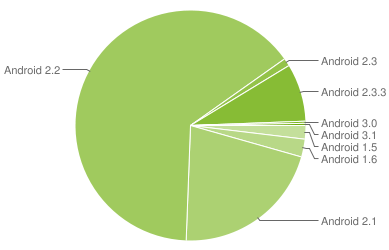
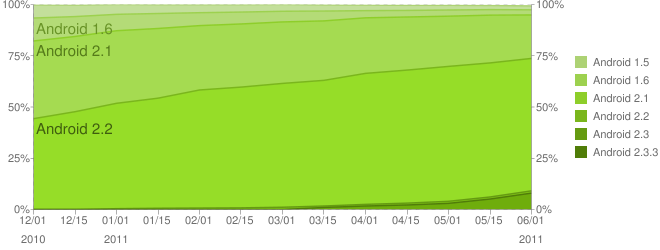
It’s that time of the month once again, Google has updated the platform version distribution charts for Android, and Gingerbread is finally gaining steam:
chart (1) table
Gingerbread now makes up a whole 9.2% of the Android ecosystem, and the Gingerbread source has been publicly available for 6 months as of today. Froyo still dominates, at around 65%, with Éclair placing second. Pre-2.1 devices now account for less than 5% of the total, which really makes the whole 2-year device-life logic seem rather silly.
chart
Honeycomb also has peaked its head above the grass, and represents a little over a half-percent of all Android devices presently (most thanks likely going to the XOOM and ASUS Transformer for that). You’ll also notice that the tablet-ized Honeycomb is mixed in with the phone versions of Android in the pie chart. Why? Because when Ice Cream Sandwich is released, all those versions will start to converge once again – phones and tablets, existing in harmony together! Or something.
Anyways, we always like when these charts are released – it really shows Google is concerned with OS fragmentation out in the wild and isn’t afraid to illustrate the present state of Android affairs, good or bad.
They’ve also added distribution data for screen size and OpenGL version, which should help developers plan out how to best spend their efforts optimizing applications.